Frozen backbone
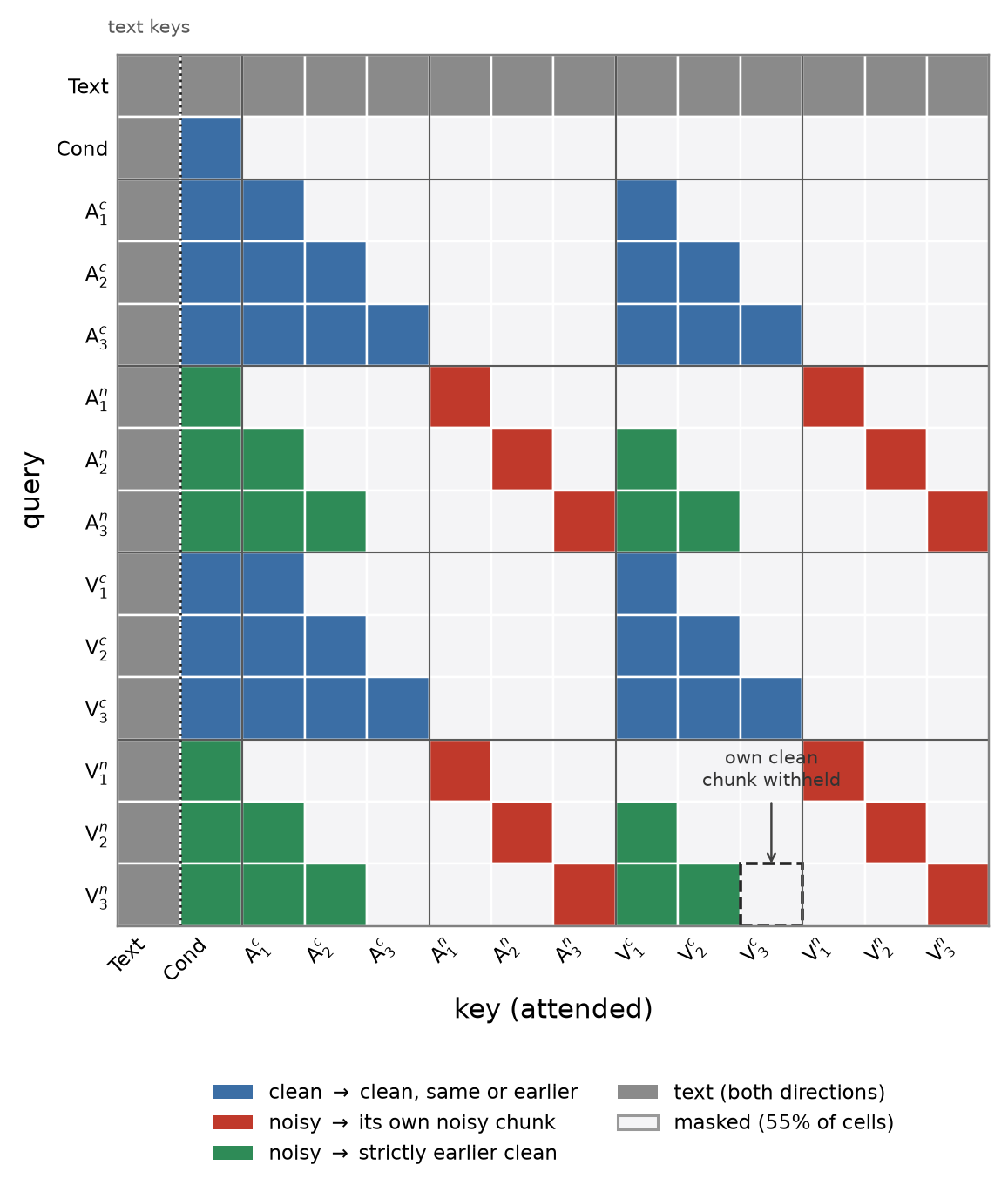
MiniMax-H3 in its first-frame-conditioned audio–video configuration. Text, a first-frame condition, video and audio form one packed sequence with three-dimensional rotary positions. The backbone is never updated.
Under review as a conference paper at ICLR 2027
Two capabilities, learned apart, added at inference.
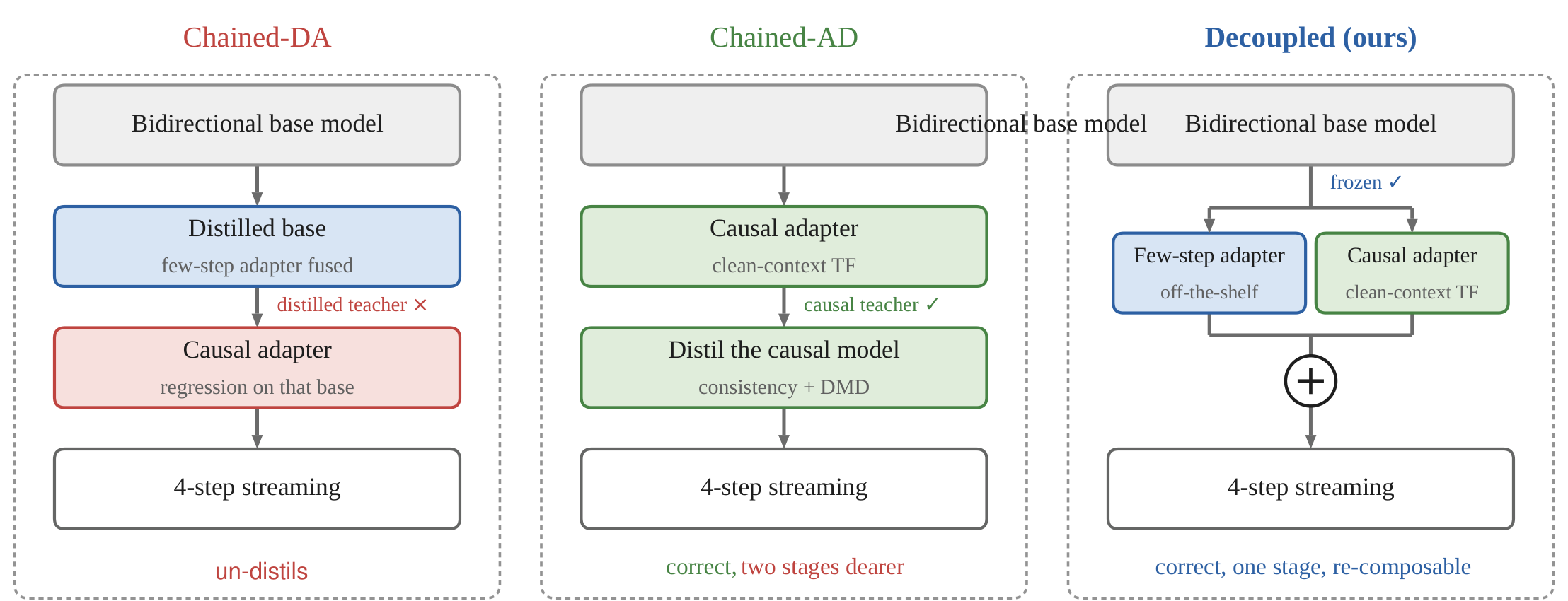
Making a joint audio–video diffusion transformer stream in real time needs two edits at once: block-causal attention, so frames leave before the clip is finished, and few-step sampling, so each chunk is cheap. The streaming literature chains them — distil, then causalise, or the reverse. We show the chain is unnecessary. Each capability is trained independently against one frozen backbone and the two updates are simply added at inference. Because they edit different functional axes — context routing versus the denoising trajectory — their weight updates write into near-orthogonal directions, which we predict and then verify. No joint training, no orthogonality constraint, no extra stages.
One frozen backbone, two independent adapters, one addition.
MiniMax-H3 in its first-frame-conditioned audio–video configuration. Text, a first-frame condition, video and audio form one packed sequence with three-dimensional rotary positions. The backbone is never updated.
Trained against the frozen backbone with clean-context teacher forcing on a doubled token axis: each chunk appears twice at identical rotary positions, once clean and once noisy, so a noisy chunk reads only strictly earlier clean ground truth. One plain flow-matching regression — the only objective we ever train.
Not trained by us. We take a public third-party 4-step distillation of the same backbone, learned under bidirectional attention where distillation is already solved. Each capability is acquired where it is cheapest; we never touch an ODE solver, an EMA target, or a critic.
W + Δd + Δc, combined by weight arithmetic at
inference. Δd is fused offline so it adds no runtime overhead;
Δc loads on top. Neither stage ever sees a base the other has altered, and
Δc stays re-composable across step counts.
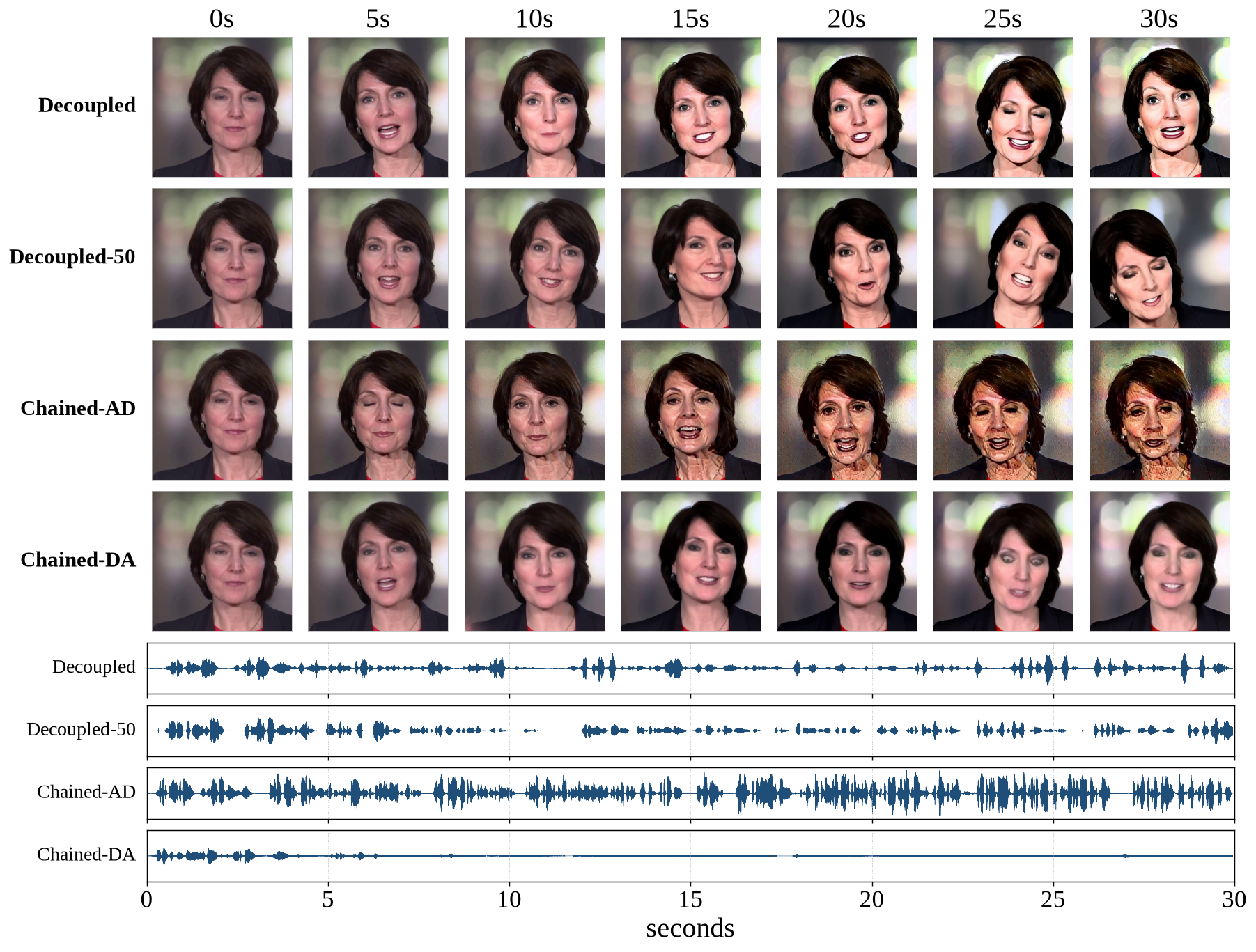
Every clip is referenced to the 50-step bidirectional teacher's own generation, so reference and generation are comparable frame by frame. Whole-seg is the same few-step adapter run bidirectionally — it isolates what causalisation costs, and removes “four steps is too few” from the account.
A causal adapter trained on 5–10 s clips, streamed to 30 s with the history capped by a sliding window. Scripts are written for 40 s so every system is still mid-sentence when the video ends — falling silent is therefore a failure, not an ending. Turn the sound on: the separation is audible before it is visible.
| System | Sync-C ↑ | Identity ↑ | CLIP ↑ | IQA ↑ | Voice ↑ | RMS |
|---|---|---|---|---|---|---|
| Decoupled | 5.69 (−29.6%) | 0.710 (−18.3%) | 0.844 (−9.7%) | 0.871 (+2.6%) | 0.521 (−41.0%) | 0.086 (−10.6%) |
| Decoupled-50 | 6.23 (−19.1%) | 0.687 (−18.9%) | 0.856 (−8.2%) | 0.848 (+3.0%) | 0.682 (−22.3%) | 0.109 (−16.6%) |
| Chained-AD | 7.82 (−12.8%) | 0.484 (−41.8%) | 0.737 (−19.7%) | 0.526 (−35.4%) | 0.608 (−31.9%) | 0.185 (+49.0%) |
| Chained-DA | 3.75 (−43.7%) | 0.683 (−21.4%) | 0.841 (−10.5%) | 0.656 (−16.2%) | 0.603 (−32.3%) | 0.047 (−37.9%) |
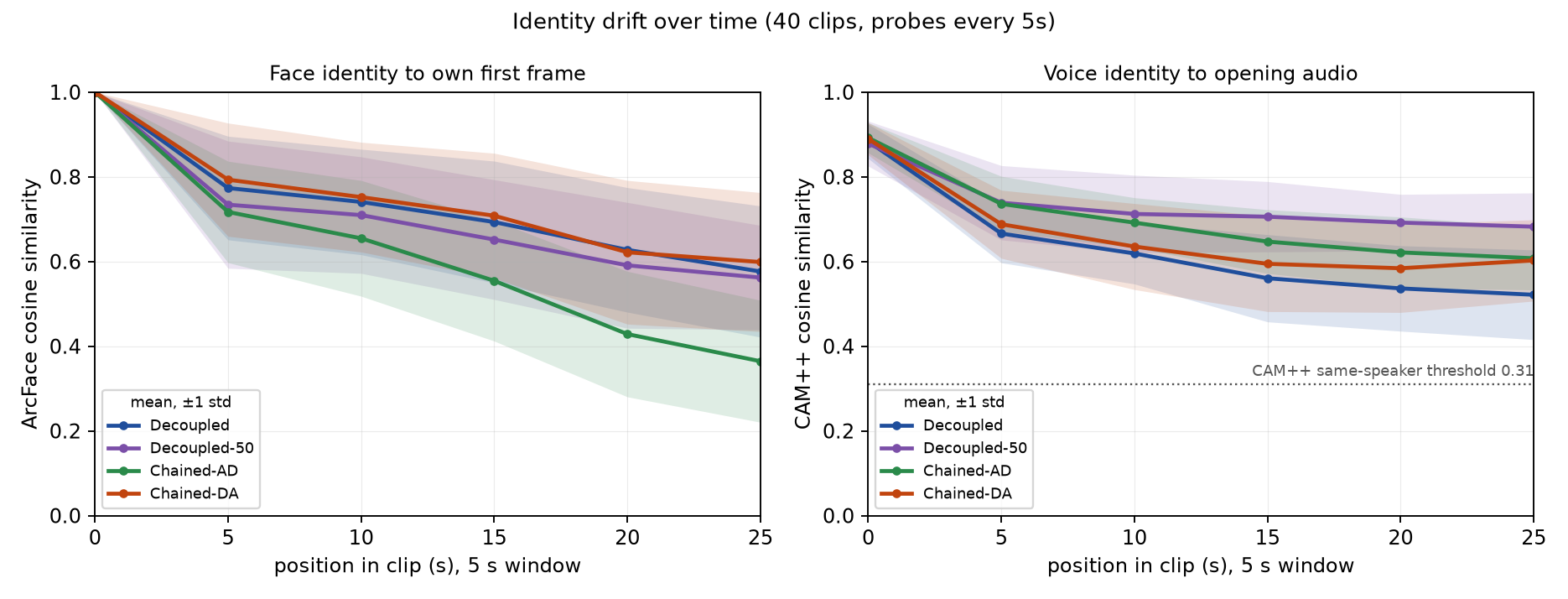
Each cell is the score on the final 5 s and, in parentheses, its change from the opening 5 s. Bold marks the best closing window; for RMS, an absolute level, it marks the smallest relative change. Decoupled closes best on identity and image quality; Chained-AD keeps the best lip sync but loses over a third of identity and image quality; Chained-DA has largely fallen silent.
The sum is safe exactly if the two updates do not interfere. Δd reparametrises the denoising map along the noise axis; Δc edits context routing — how a token aggregates clean history through the cache. Different input factors, so near-orthogonal writes are the default and interference is what would need explaining.
| Measurement | Decoupled | Chained-DA | Chained-AD | null |
|---|---|---|---|---|
| Projection | +0.0006 | −0.0022 | −0.0008 | +0.0000 |
| Write interference | 0.0147 | 0.0169 | 0.0451 | 0.0117 |
| Read interference | 0.1356 | 0.1061 | 0.1844 | 0.0237 |
W, inside
the tangent regime where weight arithmetic is expected to behave.
| Metric | Teacher50 step | Whole-seg4 step | Decoupled4 step, ours | Decoupled-5050 step | Chained-DA4 step | Chained-AD4 step |
|---|---|---|---|---|---|---|
| Sync-C ↑ | 8.412 | 8.403 | 7.443 | 7.197 | 6.389 | 8.021 |
| AV-IB ↑ | 0.414 | 0.414 | 0.403 | 0.423 | 0.363 | 0.419 |
| IQA ↑ | 0.908 | 0.915 | 0.914 | 0.894 | 0.854 | 0.877 |
| ASE ↑ | 5.048 | 5.110 | 5.106 | 5.023 | 5.019 | 5.008 |
| CLIP ↑ | 0.212 | 0.212 | 0.212 | 0.210 | 0.212 | 0.212 |
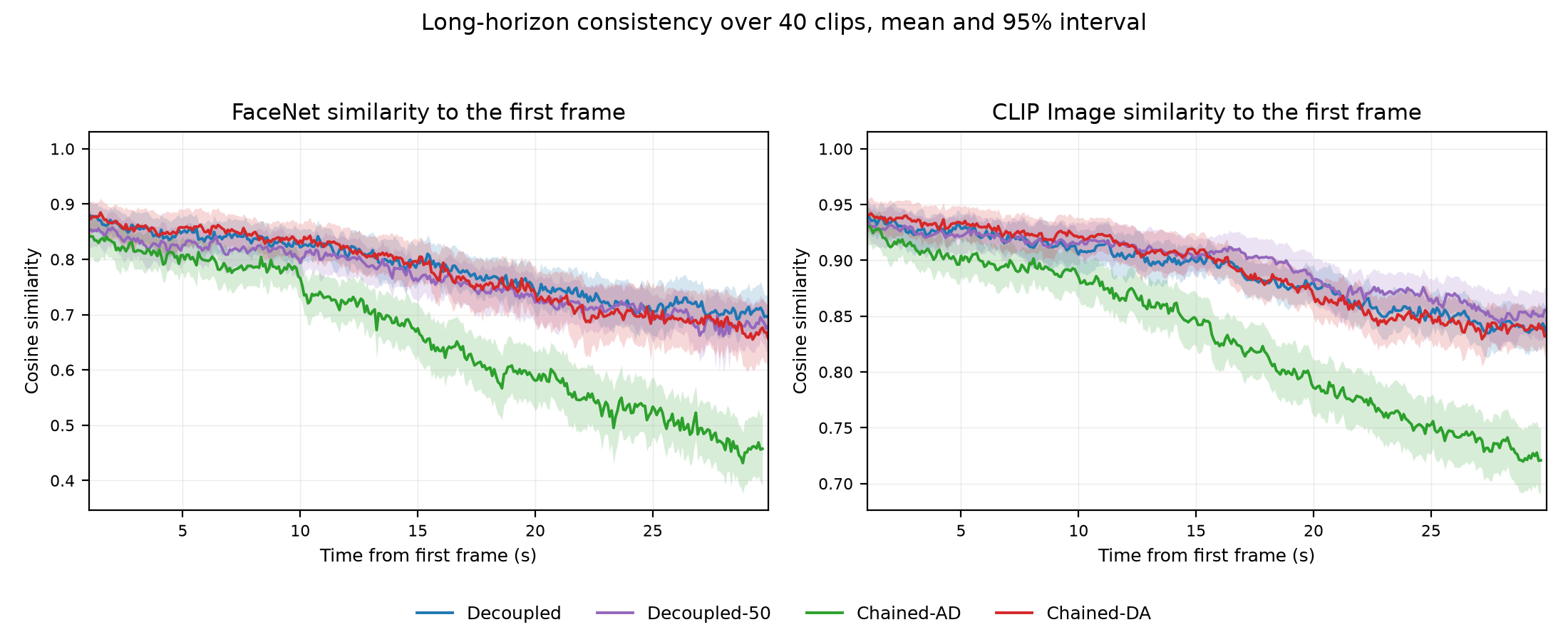
| CSIM-1st ↑ | 0.886 | 0.870 | 0.864 | 0.853 | 0.871 | 0.835 |
| IQA drift | 1.005 | 1.008 | 1.030 | 1.026 | 1.002 | 0.990 |
| CSIM drift | 0.981 | 0.981 | 0.950 | 0.948 | 0.945 | 0.916 |
| WER (En) ↓ | 0.041 | 0.047 | 0.127 | 0.110 | 0.126 | 0.136 |
| CER (Zh) ↓ | 0.014 | 0.008 | 0.051 | 0.055 | 0.061 | 0.061 |
Bold marks the best of the four autoregressive systems per row; for the drift rows, the closest to 1. Speech is transcribed with Qwen3-ASR-1.7B: WER for the English clips, CER for the Chinese ones.
Whole-seg → Decoupled varies only the attention layout: IQA 0.915 → 0.914, ASE 5.110 → 5.106, CLIP unchanged, FID 66.18 → 66.15 — below the teacher's floor of 67.10.
Speech: intelligibility (WER 0.047 → 0.127), lip–speech coupling (Sync-C 8.403 → 7.443) and the audio distribution. All three need the model to know where it is in the script; chunkwise attention leaves only the audio history to infer it from.
Chained-DA falls behind on appearance, synchronisation and speech, and its FID rises above the teacher's floor (70.31 against 67.10) while Decoupled stays below it (66.15) — the un-distillation the method section predicts.
Chained-AD distils last with sampler-aware objectives and buys back the best lip sync of any 4-step configuration, at the price of appearance and identity (IQA 0.877 against 0.914) and two extra training stages.
100 held-out clips each. The teacher is a system under test here, not the reference.
| System | IQA ↑ | Sync-C ↑ | AV-IB ↑ | DeSync ↓ | CSIM-r ↑ | FID ↓ | FVD ↓ |
|---|---|---|---|---|---|---|---|
| AVSpeech (n = 100) | |||||||
| GT (source) | 0.852 | 6.82 | 0.377 | 0.115 | 0.867 | — | — |
| Teacher | 0.857 | 8.49 | 0.333 | 0.028 | 0.839 | 32.2 | 128.5 |
| Whole-seg | 0.835 | 7.82 | 0.328 | 0.040 | 0.864 | 33.7 | 119.2 |
| Decoupled | 0.866 | 7.54 | 0.334 | 0.007 | 0.791 | 35.2 | 129.0 |
| Decoupled-50 | 0.836 | 7.13 | 0.324 | 0.028 | 0.761 | 38.9 | 143.6 |
| Chained-AD | 0.804 | 8.39 | 0.305 | 0.012 | 0.741 | 38.8 | 150.0 |
| Chained-DA | 0.803 | 6.10 | 0.290 | 0.023 | 0.790 | 40.2 | 131.9 |
| VidChatBench (n = 100) | |||||||
| GT (source) | 0.770 | 5.23 | 0.404 | 0.081 | 0.797 | — | — |
| Teacher | 0.769 | 7.32 | 0.328 | 0.022 | 0.725 | 38.1 | 171.4 |
| Whole-seg | 0.712 | 6.69 | 0.319 | 0.022 | 0.752 | 40.5 | 178.9 |
| Decoupled | 0.866 | 7.84 | 0.353 | 0.024 | 0.774 | 39.6 | 184.0 |
| Decoupled-50 | 0.829 | 7.65 | 0.348 | 0.036 | 0.758 | 41.3 | 191.5 |
| Chained-AD | 0.742 | 7.85 | 0.336 | 0.031 | 0.698 | 42.4 | 203.0 |
| Chained-DA | 0.776 | 6.70 | 0.302 | 0.034 | 0.775 | 43.5 | 193.8 |
| HDTF (n = 100) | |||||||
| GT (source) | 0.877 | 8.24 | 0.330 | — | 0.937 | — | — |
| Teacher | 0.874 | 8.94 | 0.297 | — | 0.919 | 13.0 | 63.6 |
| Whole-seg | 0.877 | 8.65 | 0.263 | — | 0.933 | 11.3 | 48.3 |
| Decoupled | 0.892 | 9.04 | 0.295 | — | 0.905 | 14.4 | 61.4 |
| Decoupled-50 | 0.880 | 8.69 | 0.270 | — | 0.902 | 15.8 | 59.2 |
| Chained-AD | 0.853 | 9.28 | 0.293 | — | 0.869 | 22.3 | 98.9 |
| Chained-DA | 0.876 | 8.58 | 0.253 | — | 0.919 | 14.2 | 49.6 |
The extra wall-clock of streaming is the key/value prefill, not the denoising steps.
Talking-head data only. Every corpus we train or evaluate on is talking-head footage, so the costs we attribute to causalisation — lip–speech coupling, the audio distribution — and the metrics that measure them are specific to this domain.
Speaker identity drifts over long sessions. The composed route holds face identity as well as any chain, but voice similarity to the clip's opening falls furthest for Decoupled (0.521 in the final 5 s, −41.0%). The few-step adapter learned the audio field under whole-sequence attention; the composed model must keep timbre from cached history alone, and the causal adapter never sees its own rollouts. A self-rollout objective is natural future work.
A single backbone. Every result is on MiniMax-H3, so whether parallel composition transfers to other joint audio–video backbones remains untested. We also do not compare against OmniForcing: it is trained on LTX-2, and a cross-backbone table would confound the generator with the recipe.
@inproceedings{anonymous2027parallel,
  title     = {Real-Time Joint Audio--Video Generation by
               Parallel Adapter Composition},
  author    = {Anonymous},
  booktitle = {Submitted to the International Conference on
               Learning Representations (ICLR)},
  year      = {2027},
  note      = {Under review}
}